

On America's First AI-Generated Chart Hit
Money talk is much louder now.


Last year, a track called “I Run” by the UK electronic duo Haven built up a significant level of organic momentum on TikTok. So much momentum, in fact, that it threatened to secure a position on the Billboard Hot One Hundred. This would have been a major milestone because the track’s distinctive vocal was created with the help of the AI music platform Suno. That means “I Run” was about to be the first obviously AI-generated track to appear on the chart. The vocal, however, proved to be the key to the track’s commercial downfall. After an “artist impersonation” complaint from Jorja Smith, who thought the voice on “I Run” sounded suspiciously like hers, the track was removed from circulation on Spotify and other platforms, thereby eliminating any hope of legitimate success.
Artist impersonation, whether accidental or otherwise, is almost unavoidable for Suno users. In my experience, each new model the company rolls out seems even more focused on generating vocals that sound exactly like existing celebrities than the last one. There are blocks in place to prevent you from using specific artist names in your prompts, but unless you’re trying very hard to get something different, most of the “female” vocals Suno generates for you will sound like Billie Eilish, Taylor Swift, or Rihanna. The producers behind “I Run” may not even have been trying to imitate Jorja Smith, but the unintentional similarity was still enough to get their song nuked off streaming services.
As I’ve discussed before, the major labels have no particular beef with AI on an ideological level. They don’t care if new hit songs are written on acoustic guitars by trained musicians or generated at the push of a button by amateur prompters. What they’re concerned with is whether or not they profit. Smith’s label going nuclear against “I Run” was not an effort to uphold the sanctity of human-made art, it was an enforcement action against an independent who wasn’t sufficiently mobbed up. The problem was that royalties weren’t flowing to the right place according to one of the three companies that owns all of the most valuable IP in the space. If the bosses had been given their piece earlier in the process, nothing about the way “I Run” had been made would have been a problem for anyone.
At this point in time, the legal status of AI-generated music is still in flux. Some lawsuits are ongoing, and others are sure to follow as theoretical conclusions get tested in the real world by human beings. In this publication’s most recent dispatch, we discussed the incentive structure surrounding AI music for artists: the tools have concrete usefulness, and even prestigious indie labels have accepted that they’re the future of music, but at this moment in time, there is basically no benefit to admitting you use them. Standard operating procedure is similar to the use of uncleared samples: if you get caught, you get caught, but it makes no sense to give people reasons to suspect you if you can help it.
The current meta, therefore, involves lying through your teeth about AI use and avoiding the use of AI-generated vocals that sound too much like other artists. Up until recently, that meant AI models were primarily useful to producers and songwriters who had the means to quickly and proficiently replace potentially problematic elements with their own production or vocals. That kind of AI use is undetectable to listeners, while providing real productivity gains to producers. This Summer, though, Fenix Flexin discovered another winning strategy: he prompted an AI platform called Treblo to generate songs in his own voice. The result was “Rubberz,” the first AI-generated chart hit in the history of American popular music. It’s been climbing the Hot One Hundred for seven weeks now, and is currently perched at number fifty-eight.
The theory that Fenix used Treblo to create “Rubberz” was publicized widely by the producer Medasin in a widely-shared video last week. The smoking gun was screenshots of demos Fenix posted to social media that still had “Sonauto,” which is what Treblo used to be called, in the file name. Curious to know more, I logged onto Treblo this morning and generated a few songs in an effort to better understand how “Rubberz” was made. It didn’t take long for me to realize that Medasin’s suspicions were absolutely on the money. As of right now, if you go on Treblo and type “Fenix Flexin” into the prompt window, the output will feature the exact same voice you hear on “Rubberz.” It’s currently possible to input your own lyrics into Treblo, but after trying it for myself, I don’t think Fenix did that. The lyrics that Treblo generates for you in response to prompts sound very, very similar to “Rubberz.” Lots of recurring motifs and imagery.
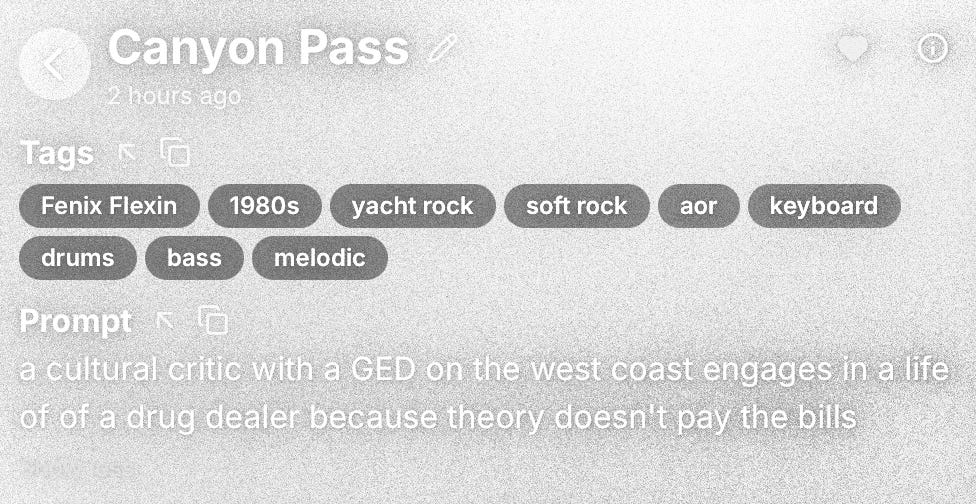
Here’s an example: this is a song I generated using Fenix Flexin’s voice this morning, and a screenshot of the prompt I used. This is a raw output—I didn’t do anything to it after I prompted it. I asked for a song about a critical theorist turning to a life of crime because “theory doesn’t pay the bills,” and Treblo wrote this, giving it the title “Canyon Pass.”
Here are the lyrics, if you’re curious:
Joad’s old pickup on the 405
Dog-eared paperbacks on the passenger side
Got my GED in a battered frame
Doesn’t help when the credit’s denied
Could talk Foucault all afternoon
But rent still comes too soon
Theory don’t pay the bills
So I move through these hills
Bag on the dash, foot on the gas
Theory don’t pay the bills
No, it never will
Got a system to surpass
Running through the canyon pass
Midnight runs through Pico-Robertson
Deleuze marked up in the glovebox hidden
Phone buzzes, another re-up
Palm trees watch what I’ve become
Could deconstruct the American dream
But the pockets stay lean
Theory don’t pay the bills
So I move through these hills
Bag on the dash, foot on the gas
Theory don’t pay the bills
No, it never will
Got a system to surpass
Running through the canyon pass
Methodology of movement
Dialectics of the dealing
Structural critique from the driver’s seat
Everybody’s got a meaning
Theory don’t pay the bills
So I move through these hills
Bag on the dash, foot on the gas
Theory don’t pay the bills
No, it never will
Got a system to surpass
Running through the canyon pass
It’s impossible to know what I’d have thought of this in a parallel universe where I encountered Treblo before ever hearing “Rubberz.” The model feels a bit clunkier and less dynamic than what Suno offers, and the outputs feel a little bit more generic than what I could get by running an open weights model through a fine-tune based on my own production. If I had no prior knowledge of or attachment to this particular voice, I might have dismissed Treblo as a primitive also-ran and found nothing about this output charming or worthwhile. Alas, though, I live in a universe where “Rubberz” is a current chart hit—a timeline that involves me absent-mindedly singing about “bankrolls on the table” to my dog because I’ve got the hook stuck in my head. As such, it’s hard not to find Treblo’s particular quirks and limitations a little bit endearing. I hear the familiar texture of Fenix Flexin’s AI-generated doppleganger crooning about how he “could deconstruct the American dream / but the pockets stay lean” and I get a kick out of it.
I don’t think “Rubberz” is a raw output like this—Fenix’s ad-libs, for example, seem genuine. After using Treblo for myself, though, it seems clear to me that the meat of the track is AI-generated. And by AI-generated, I mean generated entirely by prompt. I don’t think this is a case of AI tools being a peripheral part of a larger workflow, or a creative stepping stone between human iterations—after using Treblo, I fully believe that for all intents and purposes, this song got written when Fenix, or someone acting on his behalf, typed something into the prompt window and hit “generate.” And now it’s on the Hot One Hundred.
So, the meta has obviously changed a bit since “I Run” was taken off Spotify last year. If a producer uses AI to generate vocals that sound like someone else’s, especially if that someone else is a signed artist with a label deal, they’re going to run into trouble. Artists using AI to impersonate themselves, though? That’s fine. As far as the industry is concerned, that’s you finding a novel way to exploit your own intellectual property. The labels don’t have any problem with that—in fact, every label under the sun is currently striking deals with AI labs specifically to chase this sort of revenue.
There’s even reason to believe that Fenix’s own label, Empire, is actively encouraging him to use AI. Why is Fenix Flexin’s voice even in Treblo’s model in the first place? Treblo’s most recent model is version three, and the previous one doesn’t recognize “Fenix Flexin” as a valid tag. As Medasin pointed out in his viral video, Fenix’s labelmate Tyga has recently started trying to capitalize on the success of “Rubberz” by releasing eighties-inflected AI-generated songs that were also created with Treblo. Is Empire working directly with Treblo to make sure their model can convincingly impersonate their artists?
The disco era provides an instructive example of this dynamic in action. As the disco craze took off, innumerable artists who were past their prime rushed to capitalize with novelty records. In nineteen seventy-nine, for example, Broadway legend Ethel Merman released The Ethel Merman Disco Album—it had been decades since she’d been an active force on the charts or on Broadway, so she had nothing to lose by following the trend. To labels, AI could come to be seen as a similar tactic, a way to make old, inert intellectual property come alive again—Tyga’s lingering microcelebrity isn’t potent enough to make it worth buying him studio time with top writers and producers, but AI might represent an opportunity to make use of it. That’s the thinking behind Udio’s forthcoming “starstruck” app, which will allow fans to “cover, reimagine, remix, and create” new AI-generated works out of whatever dusty, unwanted IP that the major labels happen to have lying around.
Of course, the success of “Rubberz” is no guarantee that sort of gambit stands any chance of working. Fenix isn’t old or past his prime—he’s a young, charismatic upstart who clearly owes his success to his own indefatigable salesmanship just as much as he owes it to the jarring novelty of Treblo’s outputs. The Ethel Merman Disco Album didn’t sell particularly well, either. I’m just trying to explain the label perspective because I feel like it might not be intuitive in the context of the culture war currently developing around AI and data centers. Book deals have been cancelled over AI use, freelance journalists have been blacklisted, YouTube institution Hank Green has paused his output in response to a firestorm of criticism after he used a Claude-ism in a video. Depending on your perspective, you might assume the labels are like teachers who will fail you for cheating. That’s not how the music industry works.
No one is going to punish Fenix Flexin for using Treblo to make “Rubberz.” His label isn’t an angry boss that’s going to fire him from music for breaking the rules. What kind of sense would that make? Since the dawn of the record industry, how many artists have blown up off the back of songs about how they’re rule-breakers who do crime? Do you think anyone from Bobby Shmurda’s label ever sat him down and asked if Mitch really did catch a body about a week ago? That’s not what labels do. If you’re watching the “Rubberz” saga unfold expecting some kind of guardrail to kick in and force music back onto the straight-and-narrow, you’re going to be waiting a long time.
Last week, for example, all three major label groups and a plethora of indies proposed a new set of qualifications that AI-generated music should have in order to chart. “Under the proposed guidelines,” their statement read. “a recording developed using AI would only qualify for chart inclusion if it meets three core criteria.” Those three criteria are:
The AI service used is properly authorised and lawful;
The track is substantially human made; and
It does not raise stream or chart manipulation concerns.
A song like “Rubberz” will have no trouble meeting these guidelines once more properly-licensed models are available. Fenix’s ad-libs and Purps on the Beat’s production flourishes would qualify it as “substantially human made” even though the lion’s share of the track was generated via prompt, and the inclusion of a stipulation about chart manipulation is frankly laughable given how much botting major label artists are already known to engage in. The labels do not want to stop AI music from proliferating, they just don’t want it to be able to make money without their involvement.
As such, it is therefore only a matter of time before we see America’s second AI-generated chart hit. As lawsuits get settled and precedent is established, the loophole that allowed Fenix to avoid making contact with the third rail that got “I Run” banished from DSPs will widen, and more and more of this stuff is going to hit the mainstream. “Rubberz” proves that existing models are already powerful enough to make this possible, and the model Fenix used pales in comparison to some of the other options on offer. If this bothers you, I get it. What bothers me more, though, is the magnitude of surveillance and copyright enforcement it would take to stop any of this from happening.
Me, personally? A lot of my favorite music emerged from raves, sound clashes, and pirate radio—situations where fully independent operators utilized whatever technology they had access to without supervision from or the participation of the mainstream music industry. I hate the idea of anyone building a massive surveillance apparatus to control how AI is used. I would much rather hear what ground-level, working-class hustlers and strivers do with these tools than let the labels decide what does or doesn’t count as a legitimate use of the tech. I would absolutely prefer weaker copyright, no matter what that means for individual artists, to a world where the major labels become even more powerful than they already are.
The reality is, though, that the labels are going to try to build that massive surveillance apparatus either way. Not to stop AI music from happening, but to claim ownership of it at the moment of conception. The likeliest outcome is the worst of both worlds—AI music being ubiquitous, but also unrelentingly corporate and creatively constrained. If you’re a committed anti-AI partisan, the success of “Rubberz” might bum you out, but in the end, you might eventually come to find it preferable to what it portends.
Theory don’t pay the bills
Great piece, thanks! I love your bottom line conclusion that weaker copyright and letting artists do what they want is preferable to the major labels owning all these outputs. I agree.
That said, I'm dumbfounded that the Fenix Flexin song you posted the video of above is even popular. To my ears, it sounds like typical lowest common denominator garbage produced by AI. Having spent time trying to create lyrics using AI, the half-baked, mediocre aspect of the lyrics in that song was blatantly obvious to me as AI produced.
But I have no doubt that it's only a matter of time before AI will be producing lyrics every bit as brilliant, original, and poetic as Joni Mitchell's or John Lennon's. That, to me, is pretty depressing.
Finally, it's fascinating to compare what is happening in the music industry with the AI witch hunt going on here on Substack and in other places over writing. I'm not that involved in the music industry, so I might have missed it, but so far I haven't seen the kind of persecution, shaming, and witch hunts in the music industry over AI-generated music that I've been seeing here over the use of AI in writing.
And I'm not sure whether publishing companies are at the same place that the major labels have reached yet, where they're totally okay with AI-produced novels as long as they're involved in making the money off of them. If the major publishing houses aren't there yet, I suspect they will be before long.